Masking vs. Filtering
A Comparative Framework for Sustainable Social Engagement

Introduction: The Architecture of Social Adaptation
For autistic individuals, navigating neurotypical (NT) social environments often requires a modification of native behavioral outputs. Historically, this has been categorized under the broad term “Masking.” However, recent advancements in neurofunctional modeling — specifically the FCLA-SFGA and NDTM frameworks — distinguish between two fundamentally different operational states: Masking (complete suppression) and Filtering (strategic modulation).
This document provides a structural comparison of these two modes, analyzing their cognitive costs, architectural impacts, and long-term sustainability. The goal is to move from a model of forced endurance to one of sustainable engagement through the deliberate use of filtering and environmental scaffolding.
1. Core Definitions
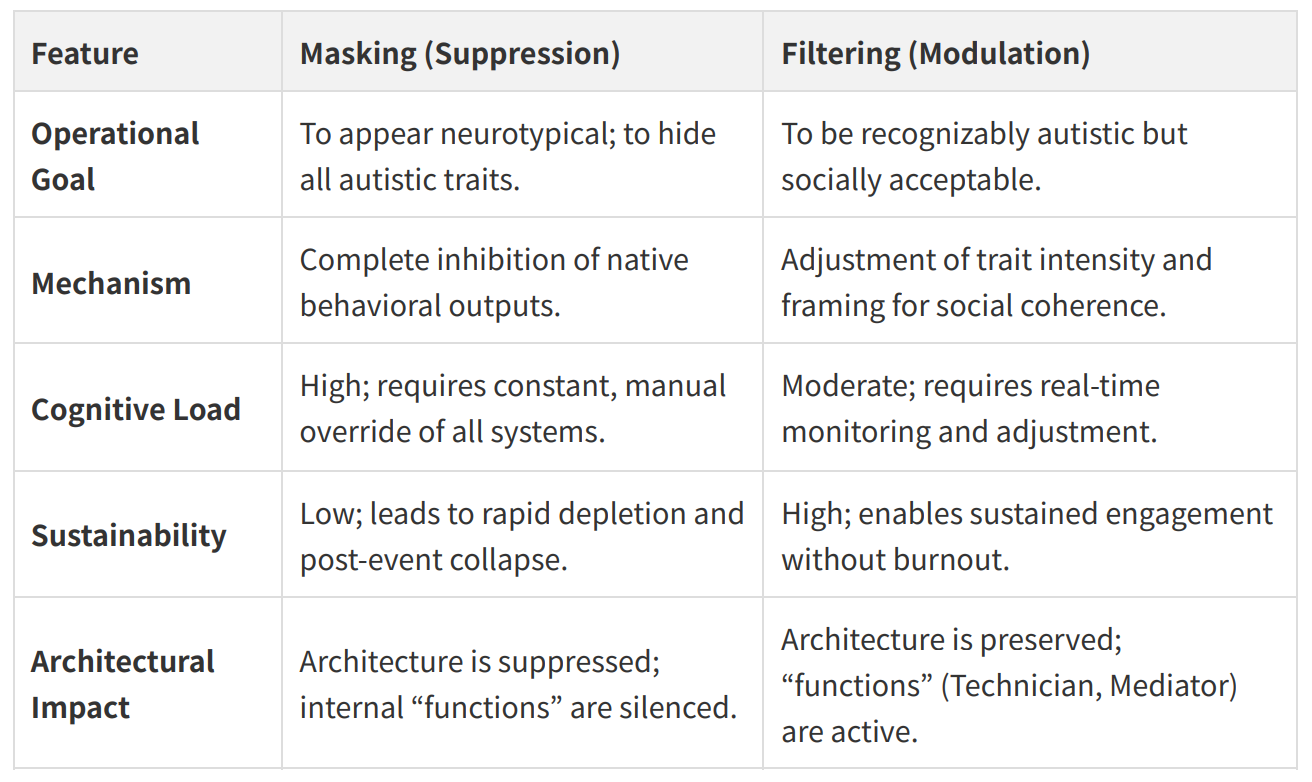
2. Structural Comparison: How They Operate
2.1 Masking: The “Off” Switch
Masking operates as a binary system. It treats autistic traits as errors to be corrected or noise to be silenced. When masking, the individual attempts to run a “Neurotypical Emulation Layer” on top of their native architecture. This emulation layer is metabolically expensive and often results in a “Black Box” effect, where the individual’s internal state is completely hidden from the environment, but the individual is also disconnected from their own sensory and emotional signals.
Internal Voice: “I must not do [Trait X]. I must look like [NT Norm Y].”
Result: The individual appears “normal” but is internally redlining. The Anchor (maintains boundaries) function is often overwhelmed, leading to a loss of boundaries.
2.2 Filtering: The “Dimmer” Switch
Filtering operates as an analog system. It treats autistic traits as valid signals that require modulation for environmental compatibility. Instead of stopping a behavior (e.g., stimming), filtering adapts the behavior into a socially coherent form (e.g., subtle fidgeting). It leverages the Technician function (practical problem-solving) to monitor the environment and adjust the “volume” of trait expression in real-time.
Internal Voice: “I need to regulate. Is this level of [Trait X] acceptable in this [Situation Frame]?”
Result: The individual is recognizably themselves, but their behavior is framed in a way that NT systems can parse without triggering a “threat” response.
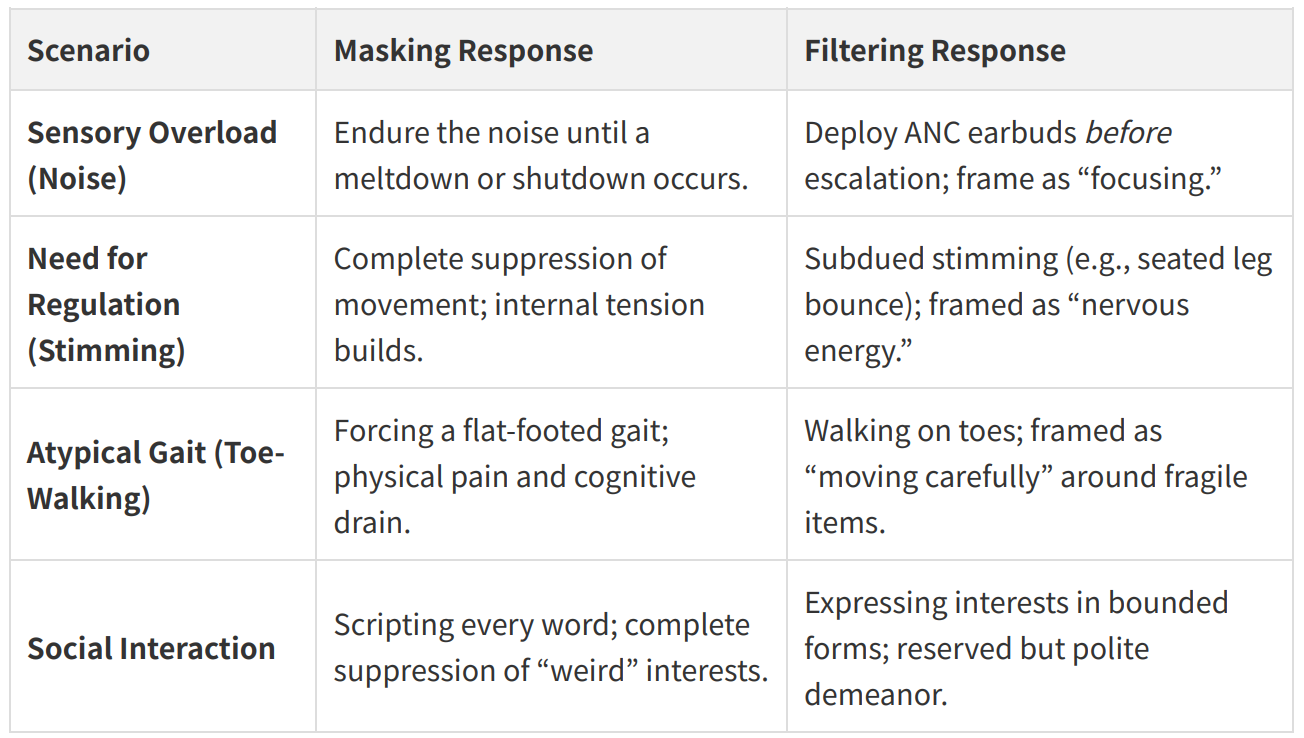
3. Comparative Case Studies
4. Impact on Cognitive Modes
The choice between masking and filtering directly affects the individual’s Cognitive Operating State:
Masking frequently forces the system into Beta-T (Threat) or Gamma (Conservation) modes. The high cost of suppression triggers the Sentinel (threat detection, environmental monitoring) function to detect social judgment as a survival threat, leading to chronic stress.
Filtering allows the system to remain in Beta-F (Flow). Because traits are being expressed (albeit modulated), the system does not experience the “pressure cooker” effect of total suppression. This enables the Explorer (curiosity, novelty-seeking, learning) and Visionary (future planning, prediction, strategy) functions to remain active.
5. Implementation Strategy: Moving from Masking to Filtering
To transition from depleting masking to sustainable filtering, the following protocols are recommended:
Identify the Signal: Recognize that discomfort (sensory, social, physical) is a signal from the Healer (physical care, rest, recovery) or Sentinel function that requires action, not endurance.
Deploy Scaffolding: Use environmental modifications (noise-canceling, temperature control) to reduce the need for modulation.
Frame, Don’t Hide: Use the Visionary function to predict how a trait will be perceived and provide a socially coherent explanation (e.g., “I’m walking carefully” vs. “I’m toe-walking”).
Monitor Energy: Use the Technician function to check the Cognitive Cost Index (CCI). If the cost of filtering becomes too high, move to an Environmental Exit or Recharge Protocol.
Conclusion: The Goal of Authenticity
The ultimate goal of filtering is not to “pass” as neurotypical, but to be authentically autistic in a way that is sustainable. Masking is a survival strategy for hostile environments; filtering is a navigation strategy for a shared world. By choosing to filter rather than mask, the individual preserves their architectural integrity, maintains their energy, and enables long-term, meaningful engagement with others.
“The goal is to be recognizably autistic but acceptable — present, not hidden; adapted, not suppressed; sustainable, not depleting.”