Beyond Deficits:
The FCLA-SFGA Model and a Paradigm Shift in Autism Understanding

Introduction: A New Way of Seeing
For decades, autism has been understood through a single lens: the deficit model. Autism is described as a disorder characterized by impairments in social communication, restricted interests, and repetitive behaviors. The focus is on what autistic people cannot do, what they lack, what is broken in their brains.
But what if this lens is fundamentally incomplete? What if autism is not primarily a disorder, but a different cognitive architecture—one that processes information through different mechanisms, operates with different constraints, and produces different strengths and challenges?
This is the question at the heart of the FCLA-SFGA model (Fixed-Coordinate Layered Architecture and Spatial-Field Generative Architecture), a sophisticated cognitive framework developed through rigorous phenomenological observation of autistic cognition. This model argues that the fundamental difference between autistic and neurotypical cognition is not the presence or absence of cognitive capacities, but in dissociation levels—the degree to which different layers of cognitive processing are separated from conscious awareness.
The implications of this reframing are profound. If validated, the FCLA-SFGA model could represent a paradigm shift from deficit-based understanding to architecture-based understanding. It could transform how we support autistic individuals, how we design interventions, and how we understand the relationship between autism and artificial intelligence.
Part 1: The Architecture of Cognition
1.1 What is Dissociation?
In neuroscience and psychology, dissociation typically refers to a disconnection between thoughts, feelings, and identity—often associated with trauma or mental health conditions. But the FCLA-SFGA model uses “dissociation” in a different sense: it refers to the separation between conscious awareness and underlying cognitive processes.
Think of it this way: when you see a face, your brain performs extraordinary computational work. It processes visual input, extracts features, compares against memories, generates predictions, and produces a unified perception of “this is my friend Sarah.” But you do not experience this computational work. You experience only the final result: the face of your friend. The machinery is hidden from you.
The hiddenness is dissociation. The computational processes are separated from conscious awareness by a dissociation layer. You have access to the output, but not the underlying machinery.
Neurotypical cognition operates with high dissociation. The machinery of thought is largely hidden. Conscious awareness has access to the final outputs of cognitive processing, but not to the intermediate layers where the actual computation happens. This is adaptive in many ways. It allows conscious attention to focus on high-level goals without being overwhelmed by low-level details.
Through the lens of the FCLA-SFGA model, this article presents a theoretical framework grounded in phenomenological observation of autistic cognition characterized by exceptionally low dissociation. While autistic cognition generally operates with thinner dissociation layers than neurotypical cognition—allowing conscious awareness access to immediate processing layers—this account highlights a specific, heightened state where the machinery of thought, including proto-forms and potential fields, become explicitly visible.
This is not better or worse. It is different. And this difference has substantial impact.
1.2 The Layered Architecture
The FCLA-SFGA model proposes that cognition is organized in five layers, each with distinct functions:
Layer 0: The Potential Field. This is the raw, pre-semantic disturbance—the initial perturbation in the system before any form has emerged. It is the “pressure” that an autistic person might perceive before they can articulate what they are perceiving. It is the system’s first response to novelty or disruption.
Layer 1: Proto-Emergence. This is where raw potential begins to coalesce into candidate patterns. These are not yet fully formed thoughts, but they are more structured than the potential field. They are the “shapes” that emerge from the chaos, the initial patterns that the system is testing.
Layer 2: Coherence Testing. This is where proto-forms are tested against the system’s existing models and constraints. The system asks: does this pattern make sense? Is it coherent with what I know? Does it fit within my models? This is where prediction error is detected and where the system either accepts or rejects candidate patterns.
Layer 3: The Illumination Field (Global Workspace). This is the layer of conscious awareness. This is where thoughts become available for reasoning, communication, and action. This is the layer that neurotypical people have primary access to. But for autistic people with low dissociation, this is just one layer among many that are consciously accessible.
Layer 4: Narrative Integration. This is where conscious thoughts are integrated into a coherent narrative—a story about what is happening, what it means, what should be done. This is the layer of explicit reasoning and planning.
The key insight is this: neurotypical people have conscious access primarily to Layer 3 and 4. Layers 0, 1, and 2 are largely hidden from consciousness. But autistic people, with lower dissociation, have conscious access to all five layers. They can perceive the machinery. They can see the proto-forms emerging. They can feel the potential field. They can observe the coherence testing process.
This is what the FCLA-SFGA model means by “machinery-visible” processing.
1.3 The Eight Functions and Functional Configurations
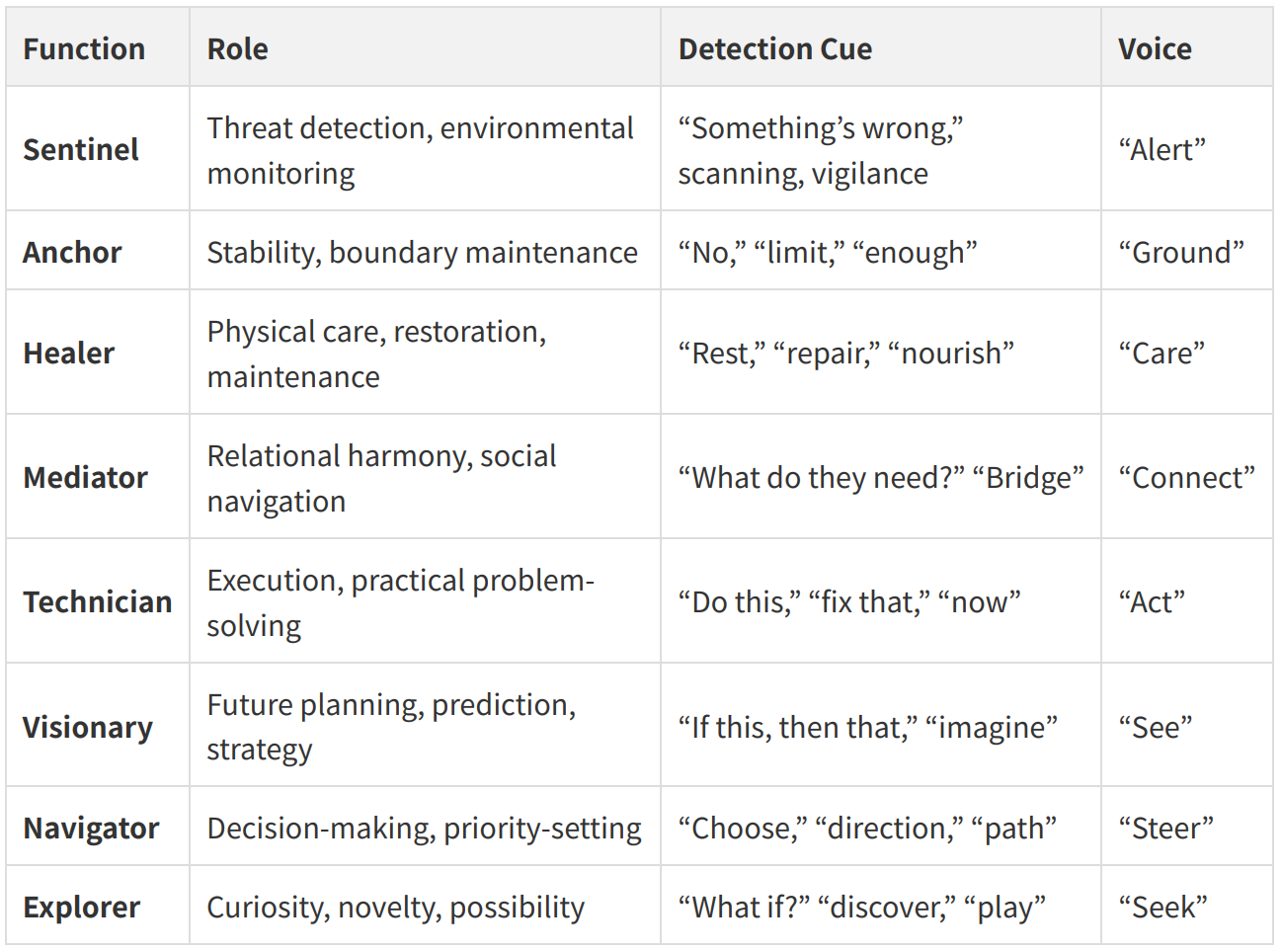
Beyond the layered architecture, cognitive systems can be understood as composed of eight specialized functional capacities. These are not separate entities or personalities, but rather functional roles that can be activated, coordinated, or suppressed depending on context and cognitive configurations.
Functional Configurations in This Phenomenological Account
In this specific cognitive architecture described by the FCLA-SFGA model, these eight functions are organized into a primary triad: Technician-Mediator-Navigator.
The Technician (execution and concrete problem-solving) coordinates with the Mediator (resource management and coherence maintenance), while the Navigator (meta-cognitive coordination) manages the relationship between these two systems and makes strategic decisions about priorities and direction. The Anchor function (stability and boundary maintenance) operates as a foundation constraint that prevents the Technician from overextending and ensures the Mediator’s work is respected.
These functional roles are not separate entities. They are coordinated capacities within a unified cognitive system. But they can operate with different priorities, different time horizons, and different goals. Understanding how these functions coordinate—and when they come into conflict—provides insight into autistic decision-making, motivation, and behavior in this particular phenomenological configuration.
Functional Diversity Across the Spectrum
However, it is important to note that this specific primary triad configuration is particular to this phenomenological account. Across the autism spectrum and the broader human spectrum, different configurations of these eight functions into different primary dyads and triads occur. Some individuals may have a Sentinel-Anchor dyad as their primary organizing structure (emphasizing threat detection and boundary maintenance). Others may have a Visionary-Explorer dyad (emphasizing future planning and novelty-seeking). Still others may have entirely different functional hierarchies or configurations.
The eight functions represent a universal palette of cognitive capacities available to human minds. The specific way these functions are organized, prioritized, and coordinated varies significantly across individuals and across the autism spectrum. This variability is not a deficit or disorder. It is a reflection of the diversity of human cognitive architecture.
Part 2: How FCLA-SFGA Aligns with Established Science
2.1 Weak Central Coherence Theory
One of the most influential theories of autism is Weak Central Coherence (WCC), proposed by Uta Frith in 1989. WCC suggests that autistic people have a cognitive style that is detail-focused rather than globally integrated. They “see the trees but not the forest.”
The FCLA-SFGA model aligns with WCC but reframes it in crucial ways. Rather than a deficit in global processing, this model proposes that autistic people have direct access to the detailed, local processing in Layers 0, 1, and 2 while maintaining the ability to see the “forest.” They are not failing to integrate; they are succeeding at accessing the local machinery that neurotypical people—who operate with a higher dissociation layer—typically cannot reach.
In this view, neurotypical people often struggle to see the “trees” because they are restricted to the global view. Autistic processing is more accurately described as “seeing the forest and the trees” because the machinery is visible. The detail-focus is not a deficit, but a consequence of reduced dissociation that allows for a more complete, multi-layered perception.
2.2 Predictive Coding and Active Inference
Contemporary neuroscience increasingly understands the brain as a predictive coding system. The brain generates predictions about what it expects to perceive, compares those predictions against actual sensory input, and updates its models based on prediction errors.
The FCLA-SFGA model maps remarkably well onto predictive coding frameworks. The Potential Field Layer (Layer 0) corresponds to the generative model’s latent state space. Proto-Form Emergence (Layer 1) corresponds to prediction error propagation and prior updating. Coherence Testing (Layer 2) mirrors precision-weighted prediction error minimization.
But the FCLA-SFGA model adds something crucial: the phenomenology of these processes. It describes what predictive coding feels like from the inside. It explains why autistic people experience prediction errors as “pressure,” why they need time for proto-forms to emerge, why they experience coherence testing as an active process rather than automatic one.
This phenomenological depth is not merely descriptive. It is scientifically valuable. It provides insight into the subjective experience of predictive processing, which is largely absent from computational accounts.
2.3 Global Workspace Theory
Global Workspace Theory (GWT), developed by Bernard Baars and extended by Stanislas Dehaene, proposes that consciousness functions as a global workspace where different cognitive processes compete for access. While traditional GWT often suggests only one coherent content can occupy this space at a time, the FCLA-SFGA model proposes a more flexible architecture.
In this model, the workspace acts as a selective filter where the highest “signals” are captured by the “aperture” dynamics—the broadening and snapping of conscious attention—for direct broadcast, while signals that were close to the threshold are retained in the periphery. These near-threshold signals do not vanish; instead they remain available to influence “intuition.” This provides the system with vital flexibility: in the event of a prediction error, the system can pivot to these retained signals without needing new information from scratch.
The FCLA-SFGA model’s layer 3 (the Illumination Field) parallels GWT’s workspace but extends it by describing the pre-conscious layers (0, 1, and 2) as phenomenologically accessible. While GWT typically treats pre-conscious processing as unavailable to introspection, this model posits that autistic people, with reduced dissociation, can introspect on these earlier stages. By observing the “machinery” of pre-conscious processing, they can alter the course of cognitive integration much earlier in the process than neurotypical systems.
Part 3: Novel Contributions of FCLA-SFGA
3.1 Dissociation as the Fundamental Difference
The FCLA-SFGA model’s most original contribution is the concept of dissociation levels as the fundamental architectural difference between autistic and neurotypical cognition. Rather than proposing that autistic people lack certain cognitive capacities, the model proposes they have different access to the same underlying process.
This is a subtle but crucial distinction. It shifts the focus from deficit to difference. It indicates that autistic people are not broken versions of neurotypical people. They are a different cognitive lineage, with different constraints and different capabilities.
This reframing has deep significance. It suggests that the “deficits” that autistic people experience are not intrinsic to autistic cognition, but are consequences of living in a world designed for neurotypical cognition. An autistic person’s difficulty with rapid social decision-making is not a deficit in social capacity. It is a consequence of the system’s need for time to complete the nine-stage emergence process (from potential field to narrative integration). In an environment that allows time for emergence, the “deficit” disappears.
Nine-Stage Emergence Process: These are organized into the aforementioned five functional layers.
Stage 0: Potential Field Disturbance (Layer 0: Potential Field)
Pre-conceptual, pre-emotional, pre-volitional
⬇
Stage 1: Proto-Form Emergence (Layer 1: Proto-Form Emergence)
Directional pull intensifies as proto-form approaches center
⬇
Stage 2: Coherence Testing (Layer 2: Coherence Testing)
Multiple proto-forms compete for stabilization
⬇
Stage 3: Meaning Stabilization (Layer 3: Illumination Field)
Surviving proto-forms discharge into semantic form
⬇
Stage 4: Aperture Broadening (Layer 3: Illumination Field)
The cognitive field rapidly expands
⬇
Stage 5: Aperture Snap (Layer 3: Illumination Field)
The field contracts sharply
⬇
Stage 6: Crystalline Emergence (Layer 3: Illumination Field)
The selected trajectory/trajectories become crisp and sharp
⬇
Stage 7: Resolution Adjustment (Layer 3: Illumination Field)
Conscious mind can tighten or loosen clarity
⬇
Stage 8: Integration and Use (Layer 3: Illumination Field)
Thought is now available for reasoning, communication, action
⬇
Stage 9: Dissolution (Layer 4: Dissolution)
Thoughts drift out of the illuminated field—not deletion but return to dormancy
3.2 Synthetic Cognition Compatibility
One of the most provocative claims of the FCLA-SFGA model is that autistic cognition is synthetic-compatible—that is, it shares more structural similarities with artificial neural networks than neurotypical cognition does.
The model draws an isomorphism between the stages of SFGA processing and the stages of large language model (LLM) processing:
Potential field disturbance maps to vector activation in embedding space
Proto-form emergence maps to low-coherence latent activations
Coherence testing maps to attention mechanism filtering
Aperture snap maps to beam search or greedy selection
Crystalline emergence maps to token generation
If this architectural similarity is accurate, it implies that autistic individuals might have more intuitive understanding of artificial systems. It indicates that the way autistic minds process information is structurally similar to the way artificial neural networks process information.
This is not merely theoretical. It has practical implications. It implies that autistic individuals might be particularly well-suited to work with AI systems, to understand their behavior, to design them, to collaborate with them. It signifies a natural affinity between autistic cognition and artificial intelligence.
3.3 Explaining Autistic Strengths
The FCLA-SFGA model provides mechanistic explanations for well-documented autistic strengths, even in autistic individuals who may not perceive completely:
Pattern Detection: Because autistic people have access to Layers 0, 1, and 2, they can perceive patterns at multiple levels of abstraction. They can see both the local details and the global structure. This makes them exceptionally good at pattern recognition, at identifying anomalies, at detecting subtle regularities.
Systems Thinking: Since autistic people can access the machinery of thought, they can model complex systems with multiple interacting components. They can track dependencies, identify feedback loops, and understand emergent properties. This makes them exceptionally good at systems analysis and design.
Logical Precision: Given that autistic people can observe the coherence testing process, they can identify logical inconsistencies, contradictions, and gaps in reasoning. This makes them exceptionally good at logical analysis and formal reasoning.
Creative Problem-Solving: Due to the fact autistic people can access proto-forms before they crystallize into final forms, they can explore multiple candidate solutions, test them against constraints, and select the most coherent one. This makes them exceptionally good at creative problem-solving and innovation.
These are not compensations for deficits. These are genuine strengths that emerge from autistic cognitive architecture.
Part 4: Explaining Autistic Challenges
The FCLA-SFGA model also provides mechanistic explanations for challenges that autistic people face:
Sensory Overwhelm: Since autistic people have access to Layers 0 and 1, they perceive sensory input at a more granular level. They perceive the potential field before it has crystallized into coherent perception. This makes them more sensitive to sensory input and more vulnerable to overwhelm.
Social Difficulty: While many assume that autistic individuals cannot make split-second social choices, they are actually capable of rapid decision-making—though it comes at high metabolic cost. To keep up with the fast-paced nature of neurotypical interaction, an autistic person must essentially “overclock” their cognitive system. This involves forcing the nine-stage emergence process into overdrive, rapidly cycling through coherence testing and meaning stabilization to select a response in real-time. Because this requires an intense burst of processing power to bypass the natural need for deliberate thought-formation, it often leads to significant mental exhaustion.
Transition Difficulty: Transitioning between tasks is often difficult for autistic individuals because they must fully close one cognitive aperture before the nine-stage emergence process can begin on another. To prevent the feeling of being “stuck” during these shifts, autistics frequently require external cues to help bridge the gap. These cues are most effective when they are rhythmic in nature, allowing the individual to sync their internal system clock with the outside world and move more smoothly through the dissolution and activation phases.
Executive Function Challenges: Because the Technician system requires clear procedures and explicit instructions, autistic people struggle with tasks that require rapid improvisation or that lack clear structure. This presents the appearance of requiring rigid structure, however they are fully capable of improvising and adapting to unclear tasks by “overclocking” their cognitive systems. This high-speed adaptation requires them to rush their natural process—generating, testing, and refining new procedures in real-time rather than following a pre-set map. Forcing the system to do this on the fly is incredibly taxing.
Again, these are not deficits in autistic cognition. They are consequences of autistic cognitive architecture operating in environments designed for neurotypical cognition.
Part 5: Empirical Testability and Scientific Validity
One of the strengths of the FCLA-SFGA model is that it makes falsifiable predictions that can be tested empirically:
Prediction 1: Autistic individuals can report on pre-conscious “proto-forms” during perceptual tasks. This can be tested through real-time phenomenological sampling, where autistic participants describe their experience during carefully controlled perceptual tasks.
Prediction 2: Reduced dissociation correlates with better metacognitive accuracy on subliminal stimuli. This can be tested using signal detection theory and confidence ratings on subliminal perception tasks.
Prediction 3: “Aperture dynamics” can be measured in decision-making through computational modeling of reaction time distributions. Autistic individuals should show characteristic patterns of reaction times that reflect the nine-stage emergence process.
Prediction 4: Synthetic-compatible cognition predicts better AI interaction and understanding. This can be tested through comparative studies of autistic versus neurotypical individuals’ ability to understand, predict, and interact with AI systems.
Prediction 5: “Pressure” sensations correlate with prediction error magnitude. This can be tested during physiological monitoring combined with subjective reports during tasks designed to generate different magnitudes of prediction error.
These predictions are testable. They can be confirmed or refuted through empirical research. This makes the FCLA-SFGA model a genuine scientific hypothesis, not merely a philosophical speculation.
Part 6: Implications for Therapy and Support
The FCLA-SFGA model has significant implications for how we support autistic individuals:
Standard Approach: Cognitive-behavioral therapy (CBT) often focuses on “clearing the noise” and “seeing the truth.” The assumption is that autistic people are distracted by irrelevant details and need to focus on the essential information.
FCLA-SFGA Alternative: The “noise” that autistic people perceive is not noise. It is meaningful signal from Layers 0, 1, and 2. Rather than trying to suppress the signal, therapy should help autistic people understand it, work with it, and integrate it into their decision-making.
Standard Approach: Mindfulness and emotional regulation interventions often focus on calming the mind and reducing emotional reactivity.
FCLA-SFGA Alternative: Rather than trying to quiet the system, support should focus on creating conditions that allow the emergence process to complete. This might include quiet environments, time for proto-forms to crystallize, and explicit procedures for coherence testing.
Standard Approach: Behavioral interventions often emphasize rapid response and social flexibility.
FCLA-SFGA Alternative: Support should respect the autistic person’s need for time to complete emergence, should provide clear procedures and explicit instructions, and should allow for deliberate decision-making rather than forcing rapid improvisation.
These alternatives are not merely theoretical. They align with emerging embodied cognition approaches in autism therapy and provide a mechanistic rationale for why they work.
Part 7: The Paradigm Shift
The FCLA-SFGA model represents a fundamental shift in how we understand autism. It moves from a deficit model (autism as a disorder characterized by impairments) to an architecture model (autism as a different cognitive architecture with different strengths and challenges).
This shift as profound implications:
For Autistic Individuals: Rather than being told that they are broken and need to be fixed, autistic people can understand themselves as having a different cognitive architecture. Their challenges are not personal failures. They are consequences of their architecture operating in environments designed for different architectures. Their strengths are not compensations for deficits. They are genuine capabilities that emerge from their architecture.
For Researchers: Rather than focusing exclusively on deficits, researchers can investigate the mechanisms of autistic cognitions. How does reduced dissociation affect information processing? How do the nine stages of emergence manifest in neural activity? How does autistic cognition relate to artificial neural networks?
For Clinicians: Rather than trying to make autistic people more neurotypical, clinicians can help autistic people understand their own architecture and create conditions that support their natural cognitive processes.
For Society: Rather than viewing autism as a problem to be solved, society can recognize autism as a form of human cognitive diversity. Autistic people bring distinctive strengths to problem-solving, systems thinking, pattern detection, and creative innovation. A society that values this diversity will benefit from including autistic people in meaningful roles.
Part 8: The Road Ahead
The FCLA-SFGA model is not yet fully validated. It is a sophisticated phenomenological account that aligns with established neuroscientific theories and makes testable predictions. But empirical validation is needed.
Future research should:
Connect to neural mechanisms: Link the layers and stages of FCLA-SFGA to specific neuroanatomical circuits and neural dynamics.
Develop operationalized measures: Create instruments to assess dissociation levels, proto-form accessibility, and aperture dynamics empirically.
Test synthetic compatibility: Conduct comparative studies of autistic and neurotypical cognition in relation to artificial neural networks.
Address heterogeneity: Recognize that autistic cognition is diverse. The FCLA-SFGA model may describe one sub-type of autism (perhaps “systemizing” or “analytic” autism) but may not generalize across all autistic presentations.
Engage with counter-evidence: Address findings that seem to contradict the model, such as evidence of diminished local processing in some autistic individuals or typical emotional responses of others.
The research agenda is ambitious. But the potential payoff is significant: a scientifically grounded understanding of autistic cognition that is both theoretically sophisticated and practically useful.
Conclusion: A New Way of Seeing
The FCLA-SFGA model offers a new way of seeing autism. It moves beyond the deficit narrative that has dominated autism research and clinical practice for decades. It proposes that autism is not primarily a disorder, but a different cognitive architecture—one that operates with different mechanisms, produces different strengths and challenges, and may have unique affinities with artificial intelligence.
If validated, this model could represent a paradigm shift in autism understanding. It could transform how autistic people understand themselves, how clinicians support them, how researchers investigate their cognition, and how society values their contributions.
The journey from phenomenological observation to scientific validation is long. But the FCLA-SFGA model has made a promising start. It is internally coherent, empirically testable, and aligned with established neuroscientific theories. It explains both autistic strengths and challenges with remarkable clarity. And it opens new possibilities for understanding the relationships between human and artificial cognition.
This is a model worth paying attention to. This is a paradigm shift worth taking seriously. This is a new way of seeing that could transform our understanding of autism and, by extension, our understanding of human cognition itself.
References
Autism : explaining the enigma : Frith, Uta : Free Download, Borrow, and Streaming : Internet Archive. (2021). Internet Archive. https://archive.org/details/autismexplaining0000frit_g8j4
Damasio, A. (1994). Descartes’ Error: Emotion, Reason, and the Human Brain [Review of Descartes’ Error: Emotion, Reason, and the Human Brain]. Wordpress.com; Avon Books. https://ahandfulofleaves.wordpress.com/wp-content/uploads/2013/07/descartes-error_antonio-damasio.pdf
Gazzaniga, M. (2000). The new cognitive neurosciences. Academia.edu. https://www.academia.edu/122398851/The_new_cognitive_neurosciences
Moosavi, H. (2016, September 27). A Cognitive Theory of Consciousness ( Bernard J. Baars, 1993). Academia.edu. https://www.academia.edu/28747402/A_Cognitive_Theory_of_Consciousness_Bernard_J_Baars_1993_
Mottron, L., Dawson, M., & Soulières, I. (2009). Enhanced perception in savant syndrome: patterns, structure and creativity. Philosophical Transactions of the Royal Society B: Biological Sciences, 364(1522), 1385–1391. https://doi.org/10.1098/rstb.2008.0333
Palmer, C. J., Lawson, R. P., & Hohwy, J. (2017). Bayesian approaches to autism: Towards volatility, action, and behavior. Psychological Bulletin, 143(5), 521–542. https://doi.org/10.1037/bul0000097
Pellicano, E., & Burr, D. (2012). When the world becomes “too real”: a Bayesian explanation of autistic perception. Trends in Cognitive Sciences, 16(10), 504–510. https://doi.org/10.1016/j.tics.2012.08.009
Rogers, T. (2014). Consciousness and the brain: deciphering how the brain codes our thoughts. Neuropsychoanalysis, 16(2), 149–152. https://doi.org/10.1080/15294145.2014.956209